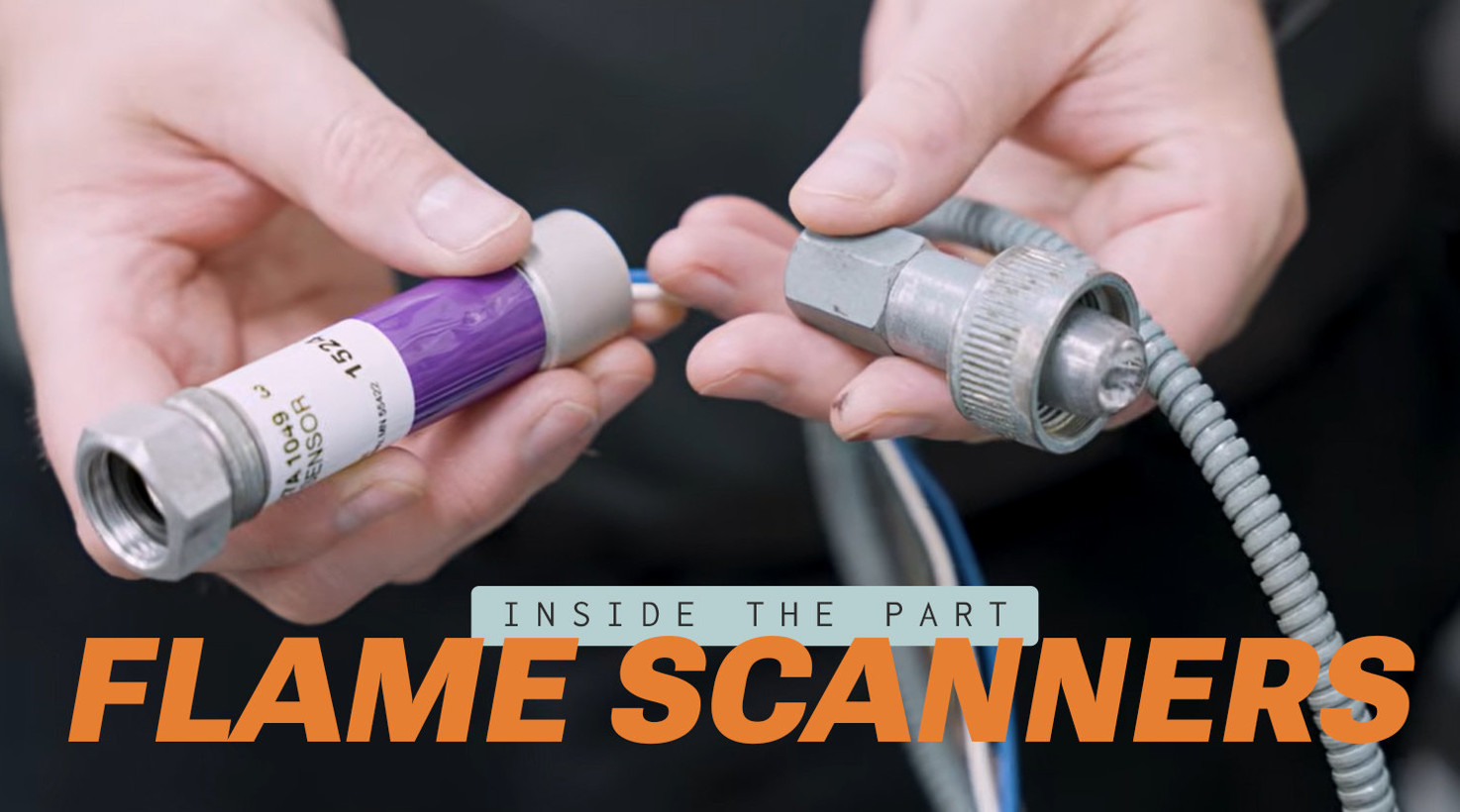
Inside the Part: Boiler flame scanner
A flame scanner is a critical boiler safety component that detects whether a burner flame is present and stable. If the scanner does not detect flame when fuel should be burning, the boiler control system can shut off the fuel supply to help prevent unburned fuel from accumulating in the fireside.
Because flame scanners play such an important role in safe boiler operation, understanding how they work, and recognizing the signs of a failing scanner, can help operators troubleshoot problems and avoid unnecessary downtime.
In this edition of Inside the Part, we’re breaking down the different types of flame scanners, how they detect flame, common signs of failure, maintenance considerations, and what to know when replacing one.
WARE’s BoilerWAREhouse.com stocks flame scanners along with 40,000+ boiler parts and gives customers access to specialists who can help identify the correct replacement for a specific boiler and burner application.
WHAT DOES A BOILER FLAME SCANNER DO?
Flame scanners are a crucial safety feature on every modern boiler. They act as the eyes of your boiler, confirming that your burners are lit and stable when they’re supposed to be, and off when they’re supposed to be.
WHY ARE FLAME SCANNERS IMPORTANT FOR BOILER SAFETY?
Flame scanners make sure that when there’s fuel flowing into your fire side, there’s a flame there to consume it. Otherwise, the unburned fuel will build up in the fire side and create a potentially hazardous situation. By confirming that a flame is present and stable, the flame scanner lets your boiler’s control system know it’s safe to feed additional fuel to the boiler. If a flame is not present when it’s supposed to be, the flame scanner will alert the boiler’s control system and turn off the fuel supply to prevent harmful fuel accumulation.
HOW DOES A FLAME SCANNER WORK?
Flame scanners use several different types of technology to detect the presence of a flame.
- UV scanners detect the specific wavelengths of ultraviolet light given off by combustion
- IR scanners look for infrared light given off by flames
- Flame-rod scanners use electrical conductivity to detect the presence of a flame
- Optical scanners use sophisticated imaging technology to identify the presence and stability of a flame
HOW TO MAINTAIN A FLAME SCANNER
There are a few different things you can do to make sure your flame scanner is well-maintained and doing its job.
- Check the flame signal daily, paying close attention to the firing rate
- Test your flame failure response time by pulling the scanner or interrupting the flame and verify correct operation
- When you pull the flame scanner to confirm operation, that’s a good time to clean and inspect it, checking for moisture, corrosion, loose wiring, or excessive heat exposure
WHAT ARE THE SIGNS OF A FAILING FLAME SCANNER?
If your flame scanner is failing, it may start giving a weak flame signal. Or, it may stop responding to flame loss. A failing flame scanner may also generate visible flashes on the detector grid without a corresponding flame.
HOW LONG DOES A FLAME SCANNER LAST?
It’s hard to judge the useful lifespan of a flame scanner because their longevity can be affected by a wide range of factors including operating conditions, maintenance intervals, and the amount of heat and vibration they endure. Typically, a flame scanner will last around 10 years, though some can last up to twice that long.
COMMON MISCONCEPTIONS ABOUT FLAME SCANNERS
The most commonly held misconception about flame scanners is that a higher flame signal is always better. Prioritizing a high flame signal can lead to the flame scanner detecting other heat sources – like hot refractory – and reporting it as a flame. So a high signal isn’t always the clearest indicator of proper flame scanner operation. In fact, a flame scanner that shows a high flame signal may actually fail to deliver proper flame failure response and generate a false positive. It may also wear out quicker. What you really want in a properly functioning flame scanner is a stable flame signal rather than a really high flame signal.
Incidentally, if a flame scanner is detecting other heat sources incorrectly, the easy fix is to use an orifice to limit its field of view to just the flame. Some operators choose to install a second type of flame-scanning technology as well, to ensure proper flame detection.
HOW DO FLAME SCANNERS WORK WITH THE BOILER CONTROLS?
Flame scanners are crucial in monitoring a boiler’s safe operation. As such, they are connected to the boiler control system, where they primarily function as an on-off/yes-no switch; if a flame is present, the fuel is allowed to flow. If there is no flame, no fuel can enter the boiler’s fire side. However, there is a new AUTOFLAME flame scanner that can modulate fuel supply and adjust combustion based on its readings, but that is currently an outlier.
If you need a new flame scanner, or if you want to upgrade your current flame scanner system, there’s no better place to get what you need than WARE’s BoilerWAREhouse. Not only do we stock a wide range of flame scanner components and parts, we also offer fast shipping in as little as one day to most of the country. We also have real experts on staff to make sure you get exactly what you need. Just let us know how we can help.