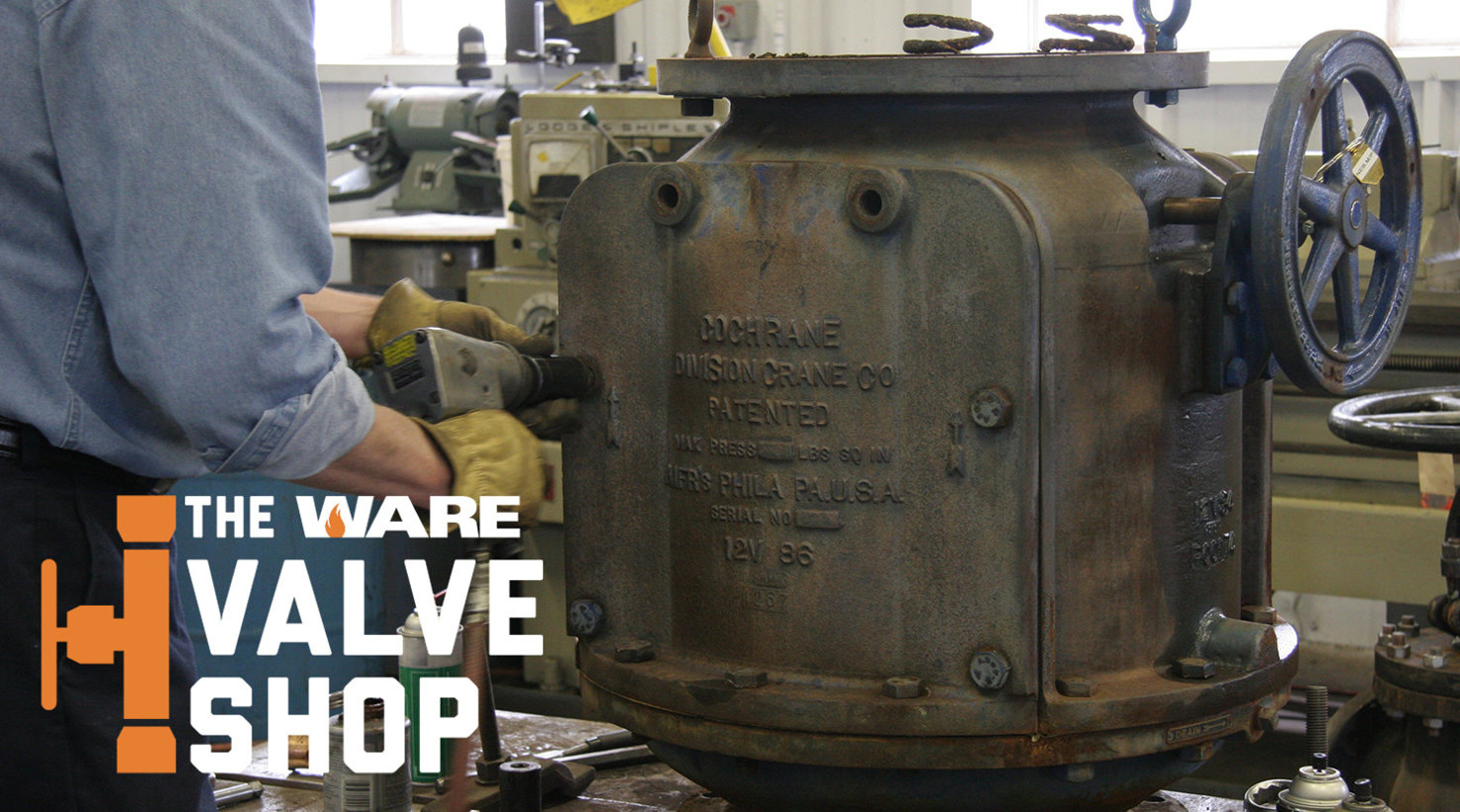
As any boiler operator knows, valves are absolutely crucial to your boiler’s performance. They keep the steam flowing, they keep the water where it’s supposed to be, and they make sure that your boiler has what it needs, when it needs it. As it turns out, the company you’ve known and trusted for all of your steam needs for the past 80 years is also your go-to resource for keeping your valves working properly.
ALL KINDS OF VALVES
WARE’s Valve Shop is our own in-house valve repair facility, and it’s known around the region for the quality work it does repairing all kinds of valves used in the boiler industry.
Ball Valves, which excel at isolation, are ideal for applications where a tight seal is needed to prevent leakage. They are quick-turn valves, meaning it only takes 90 degrees of handle movement to turn them all the way off or all the way on. Ball valves feature a housing with a ball mounted inside that has a hole cut through it along its horizontal axis. As the ball is rotated by the actuation lever, the hole comes into alignment with the flow of steam or water, allowing it to pass through. As the valve is turned off, the hole becomes perpendicular to the flow of water or steam, preventing it from flowing through.
Gate Valves operate by raising and lowering a gate across the flow of steam or water as the handle is turned. Because it takes multiple turns of the handle to move the gate through its full range of motion, gate valves are considered slow-open valves. While they can be used for modulating applications because the gate can be opened or closed gradually, they are ideally suited for isolation applications that require a tight seal.
Globe Valves operate in a manner similar to gate valves, but instead of raising and lowering a gate, they raise and lower a disc or plug that fits into a seat in the valve housing. They are ideal for flow modulation, because they allow precise control of the amount of steam or water flowing through. In fact, many of the globe valves that the Valve Shop manufactures have markings on the outside of the housing to indicate the degree to which the plug or disc opens or closes as the handle turns.
The Valve Shop also repairs valves for specific applications, as well, including:
Pressure Relief Valves, safety valves that prevent line pressure from getting too high by releasing steam when the pressure exceeds a set point. One of the most popular designs is also one of the oldest, the Kunkle Valve, developed in 1875. It uses a seated disc that’s held in position by spring tension. When the pressure is greater than the strength of the spring tension, the disk moves to release the pressure.
Check Valves, which are used to ensure that steam or water can only flow in one direction. They feature a disc that is held open by gravity or by spring tension. When the flow reverses, the disc is pressed back into its seat, sealing the opening and preventing any steam or water from flowing the wrong way.
Pressure Reducing Valves that are used to step down the pressure of steam, water, fuel oil, natural gas, and propane to the required level. They are often found between the utility supply line and the gas train or fuel train, because utility pressures can be higher than the gas or fuel train requires. They’re also found between steam supply lines and end work processes, because many work processes require lower steam pressure to operate properly.
Fuel Oil Valves that are used to control the amount of fuel oil flowing into an oil-fired boiler, to allow the oil to be properly atomized and mixed with air to ensure efficient combustion. They are also used to shut off the fuel oil supply when the boiler’s furnace needs to be shut down.
Gas Valves that are used to regulate the amount of gas that flows into the fuel train, or into the boiler itself, to keep the flow of gas at the right level for proper combustion.
MADE RIGHT HERE
While the Valve Shop excels at repairing valves, it’s also the place where one of the industry’s best valves is hand-assembled by true boiler valve experts. We’re talking about the WARE Mod-V Modulating Feedwater Valve. Used to adjust the flow of feedwater to keep the boiler producing steam at a desired rate, the Mod-V Valve was designed by the experts at WARE to be the finest modulating feedwater valve in the industry.
The Mod-V valve is a ball valve with a high-grade polymer seat, a 60-degree V-port design, and a highly polished ball for smooth, reliable operation. It’s built with WARE’s bulletproof non-slip linkage, so it continues to provide accurate control cycle after cycle. The Mod-V valve is Class 6 bubble tight, meaning it won’t leak. It’s usually supplied with Honeywell or Jacobson modulating motors, chosen for their long life and reliability.
If you have a valve that’s leaking, sticking, or starting to fail, WARE’s Valve Shop can restore it to perfect working order for less than you’d pay to replace it with a new valve. Our shop technicians are skills craftspeople who know boilers and their valves inside and out, and are ready to help whenever you need them. Of course, if you need anything else for your boiler, including parts and supplies, or if you’d like to learn more about boiler operation from our in-house training facility Boiler University, we’re glad to help with that, too. Just let us know.